
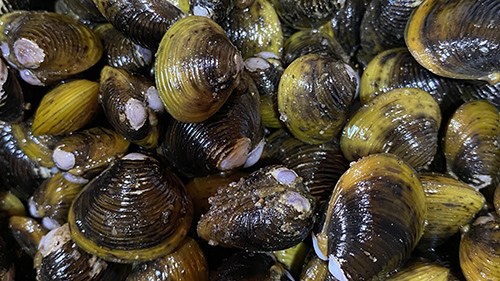
Clams don’t see borders, and collaboration is key to slowing their spread across Aotearoa New Zealand.
Three years ago, invasive freshwater clams were discovered at Bob’s Landing in Lake Karāpiro. Since then, regional councils, mana whenua, government agencies and research organisations have been working together to understand how this pest behaves in Aotearoa New Zealand, and how we can stop the spread.
Exploring what lies beneath
ESNZ’s Michele Melchior hauls clams and sediment back to shore for counting. Photo credit: Maddy Brennan (ESNZ).
On one of the many sunny autumn days in May, Earth Science New Zealand (ESNZ) and Waikato Regional Council returned to the awa for their third two-week population study since 2023.
These studies are helping the team understand how the clams are moving through the river, and why they show up in some places but not others.
The ESNZ divers head to the deeper parts of the river and haul back bags of sediment and clams for the team on shore to start their tedious count. The juvenile clams are tiny, and tweezers are used to carefully separate clam from sediment.
It’s a confronting sight, but it’s exactly this kind of data that is helping the team understand how fast the clam is spreading, and how to respond.
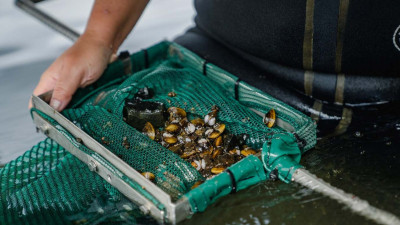
ESNZ’s Michele Melchior hauls clams and sediment back to shore for counting. Photo credit: Maddy Brennan (ESNZ).
Back in the lab the following week, we’re taken to ESNZ and shown what’s dubbed the ‘vile vial’, a sample of river water with approximately 900 baby clams floating inside.
As hermaphrodites, a single clam can self-fertilise and produce up to 400 juveniles a day and up to 70,000 a year.
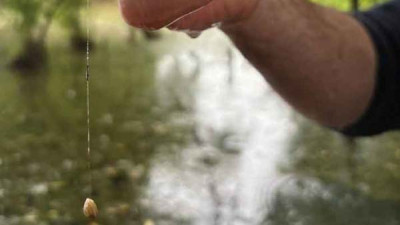
The team explain that when the clams are young, they use a sticky thread-like attachment to help them move through the water.
Juveniles can be tinier than a grain of sand, and it is easy to see how they can hitch a ride on almost anything that enters the water.
Building the toolkit
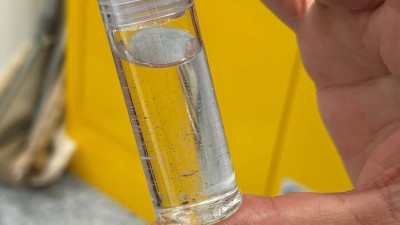
Alex Fear, Senior Communications Advisor at ESNZ, has dubbed this sample the “vile vial” containing ~900 baby clams.
While nationwide eradication isn’t considered feasible, the focus has shifted to something just as important: managing the spread.
ESNZ is carrying out world-leading research on the clams, building on what has already been done overseas.
At the back of an old schoolhouse at Innovation Park, Ruakura, ESNZ is researching whether clams can be killed using benthic barriers, a tool traditionally used to control aquatic weeds.
Essentially, they are trying to work out the best way to smother the clams, using a kind of weed mat (EPDM rubber liner) that can be laid over lake and riverbeds to reduce their oxygen supply.
Benthic barriers are being explored as a tool for new detections; if the clams haven’t been at a site for too long, there’s a chance we can smother them.
Alongside benthic barriers, scientists are exploring a wider toolkit for controlling the clam, including early-stage research into whether sound could be used to disrupt larvae life-stages.
Turning the research into action
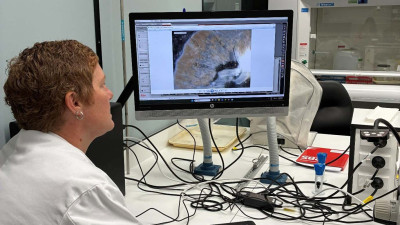
Karen Thompson, Principal Technician ESNZ shows hundreds of eggs (pictured as brown matter) inside a clam.
Slowing the spread comes down to something simple: people taking action. Every time someone checks, cleans and dries their boat and gear, it reduces the risk of a clam reaching a new waterway.
The Check Clean Dry programme is a partnership involving iwi, regional councils, the Department of Conservation, Land Information New Zealand, Fish & Game, energy companies, and Biosecurity New Zealand. At the forefront of the programme, efforts are focused on supporting recreational water users to play their part in protecting New Zealand’s lakes and rivers from clams and other unwanted pests.
Each summer, Check Clean Dry ambassadors head to lakesides and riverbanks in the Waikato and across the country, sharing simple steps people can take before moving between waterways.
Whether it’s a quick chat between casting a fishing line or deflating a paddleboard, these small conversations build awareness over time.
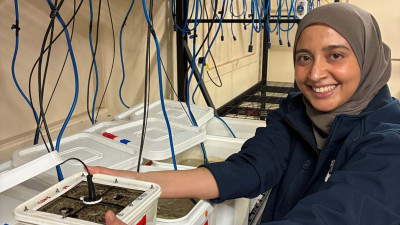
Harizah Hariz, Earth Sciences New Zealand Freshwater Pollution Mitigation Scientist with the benthic barrier.
But the Check Clean Dry message won’t work on its own, awareness around freshwater pests is equally as important, especially among tamariki, who aren’t afraid to act as champions for the environment.
That was recently proven in Taranaki, when a 10-year-old fishing in Lake Rotomanu recognised an invasive freshwater clam and sounded the alarm. After seeing a display at a biosecurity sausage sizzle, he realised he had come across one earlier, prompting immediate action.
The Waikato Regional Council biosecurity and education teams are working with schools across the region to spread the word about invasive species. Working with Enviroschools and Kura Waitī, this year has a particular focus on weaving whakapapa, pūrākau and science to make invasive species learning meaningful.
New invasive koi resources in reo have successfully been piloted across 10 kura in the Waikato, and the clam is next on the list for later in the year.
What’s next?
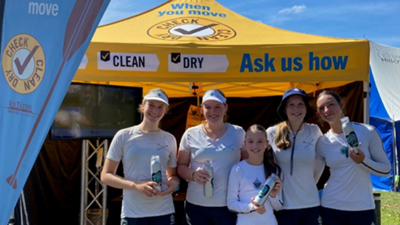
Check Clean Dry tent at Maadi Cup, Karāpiro, Waikato Credit: MRD
Three years on, the Waikato is still right at the heart of the clam action, and Waikato Regional Council's Biosecurity team is committed to working closely with other regional councils, mana whenua and communities to share knowledge and experience. Clams don’t see borders, and collaboration is key to slowing their spread across Aotearoa New Zealand.
From developing new hot water treatment methods to bringing more tamariki on the journey through art, Waikato Regional Council is focused on sharing what works, and making sure councils are prepared for future detections.
While the science is still evolving, one message is clear for recreational water users: Check, Clean, Dry when you’re moving to another waterway.