
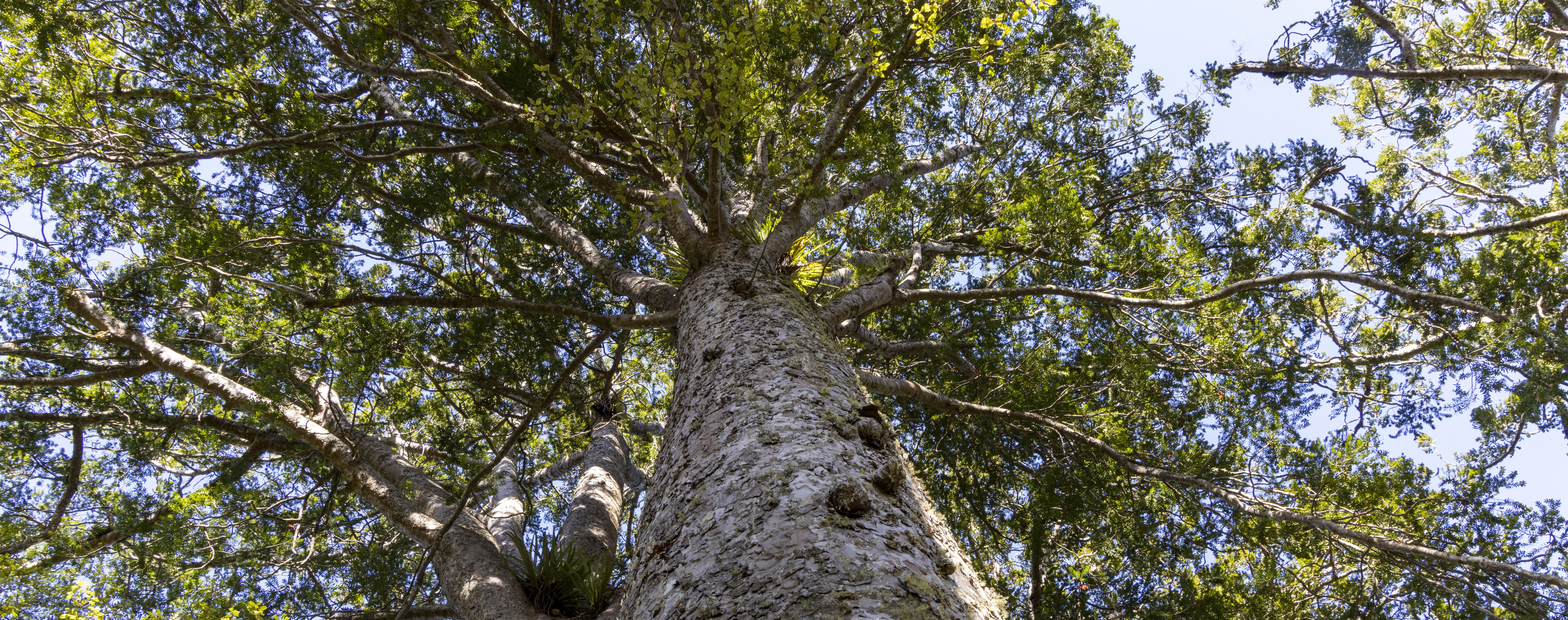
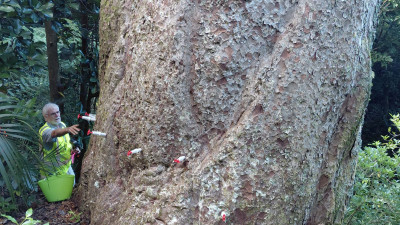
Ian Horner injecting the 1200-year-old kauri in Long Bay Scenic Reserve, near Coromandel.
It’s human nature to want to help protect kauri, believes Dr Ian Horner.
A leading plant pathologist in New Zealand, Ian helped set up the citizen science project Kauri Rescue, which uses science and community action to help save kauri trees from the deadly kauri dieback disease.
Kauri Rescue, which operates mainly in the Auckland region and surrounding areas where kauri dieback disease is more widespread, is starting to help landowners in the Waikato region, which has just a handful of sites in the Coromandel Peninsula.
The not-for-profit organisation also works closely with Tiakina Kauri, the national programme that leads and coordinates kauri protection across New Zealand, regional councils, territorial authorities and local mana whenua.
Ian, who sits on the board of the Kauri Rescue Charitable Trust and volunteers his time, has recently treated with phosphite a 1,200-year-old kauri in the Long Bay Scenic Reserve, near Coromandel town. Kauri Rescue has also been working in Kennedy Bay, on the east coast of the Coromandel Peninsula, training landowners to recognise the disease and protect their own trees.
Ian says Kauri Rescue arms landowners with the knowledge and tools to identify symptoms, safely treat infected trees using phosphite injections, monitor tree health over time, and reduce the risk of spreading the disease on their property.
“We’ll do lab testing if needed to determine the presence of PA, and we provide landowners with the training, the drills, injectors, and even the pencils to record the data,” he says. “And it’s all free.”
PA, or Phytophthora agathidicida, is the soil-borne pathogen responsible for kauri dieback disease. It infects the roots and spreads to the lower trunk, preventing the tree from taking up and transporting water and nutrients, which slowly weakens and eventually kills it.
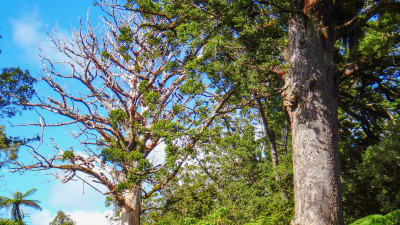
A large kauri killed by kauri dieback disease adjacent to healthy tree in Waipoua forest.
The disease was first recognised as a serious threat in 2006, after dead and dying mature kauri were discovered in northern New Zealand forests.
“Before we knew the cause we were wandering around the Waitākere and Waipoua, wondering why these trees were dying,” says Ian, who worked for Plant & Food Research at the time and quickly became involved in investigating the problem.
“When you go into a kauri forest and stand next to these magnificent trees, it is awe-inspiring. To see them fallen around you, it’s impossible not to be moved by that.
“It’s human nature to want to do something to help. It’s become a passion more than a job.”
Ian had spent decades researching the use of phosphite to treat plant diseases in the horticultural industry.
Drawing on this experience, he led trials using phosphite on infected and symptomatic kauri, first in the lab, then the glasshouse and finally in the forest.
Phosphite, “a simple molecule, H3PO3”, is injected into the trunk of trees to suppress the pathogen and boost the trees’ natural defences. It stimulates the tree to fight back against the disease.
The first forest trials in 2012 included 162 kauri trees across four test sites in the Waitākere Ranges and Northland.
“I just about started singing in the bush the first time I assessed a forest trial,” he says.
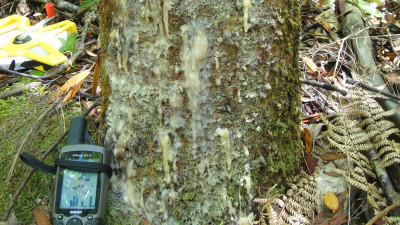
Lesions on the trunk, or patches of bleeding gum, is a key symptom of an infected tree.
Lesions on the trunks of the trees, a key symptom of an infected tree, were drying up. “The bark was healing.”
In one trial of 42 diseased kauri in Raetea Forest, 14 were left untreated for comparison. More than a decade later, all 28 phosphite-treated trees are still alive and regrowing, while of the untreated group, eight have died and six are in very poor health.
“Treatment probably needs to be done every five to six years, but it shows how well it can work,” says Ian.
“You can start to see the effects within a few months. Lesions start to dry. After a couple of years, dead, infected bark starts to peel off, and the tree produces new healthy tissue. After five to six years, if you’ve treated a tree early enough, you’ll even start to see leaves and shoots regrow.
“If a tree is defoliated, you will not save it. But in the early stages, you will get long-term survival with the right treatment. The alternative is, without treatment, almost all infected trees will die.”
The success of the trials led to the creation of Kauri Rescue, initially supported by funding from the National Science Challenge.
“By about 2015, we were getting requests from the public: ‘How do we get this for our trees?’ We had enough information to know phosphite treatment worked, so we put in a bid for a citizen science project to treat diseased kauri on private land and collect data on treatment approaches.”
Now largely volunteer-driven, Kauri Rescue brings together scientists and landowners to protect kauri on private property. To date, the trust has helped safeguard more than 5,000 trees across more than 200 properties.
But Ian is clear that treatment is not the answer to preventing the spread of kauri dieback.
“The key is getting the soil off your boots,” he says.
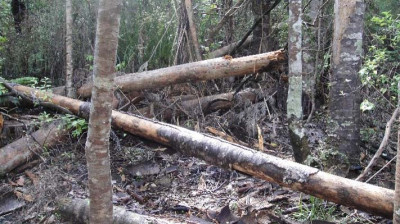
Fallen kauri rickers in a diseased stand in Waitākere Ranges.
“The pathogen lives in the soil, so if you move dirt, you move the disease. Good hygiene is the most effective way to protect kauri forests. Don’t turn up with dirty boots. You need to turn up with boots you could eat your dinner off. And if you leave a forest with dirt on your boots, take them off and scrub them clean before you wear them anywhere else.”
“Phosphite gives us a tool to help trees that are already sick or threatened, but hygiene is what protects the forest as a whole.”
Find out more about Kauri Rescue at kaurirescue.org.nz