
“The funding will provide crucial support for the long-term restoration project.”
- Hannah Rogers, volunteer.
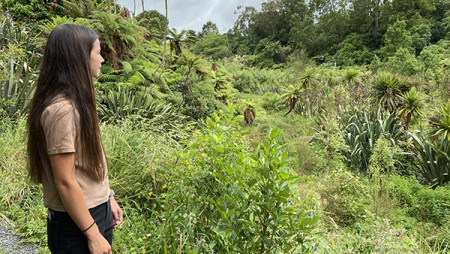
Volunteer Hannah surveys an area of Mangaonua Gully where a team regularly work on planting and weeding activities
A team of dedicated volunteers are restoring a formerly rubbish-strewn gully back to its original biodiversity while also fostering a sense of community engagement and guardianship.
The Friends of Mangaonua Esplanade Society has been working since around 2017 on improving a southern area of the 20ha Mangaonua Gully, sandwiched between Chelmsford Park and Silverdale Road in Hamilton.
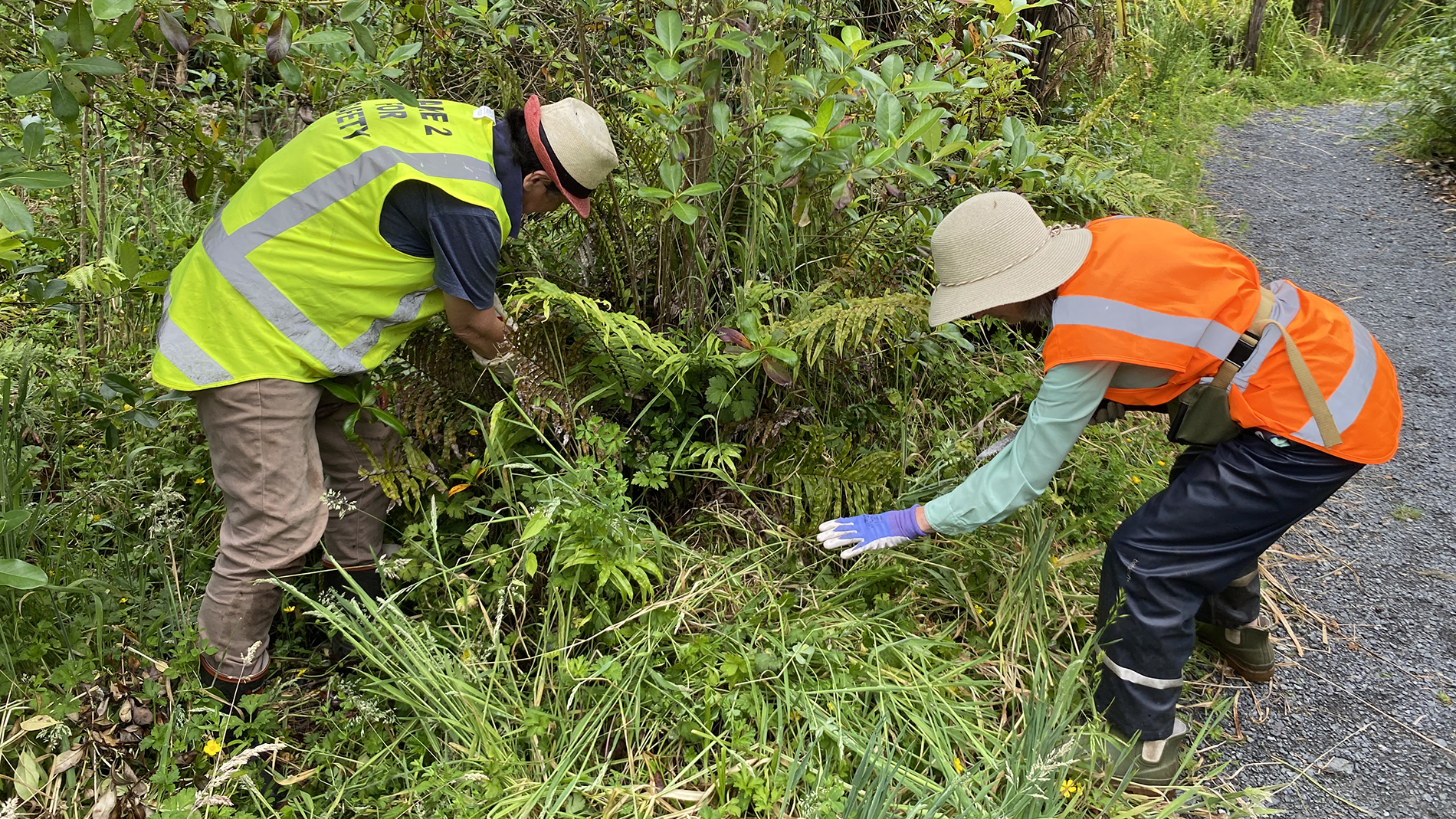
A core group of 15 volunteers are regularly on site, weeding and planting, and in general making the gully a more pleasant place. They also oversee pest animal trapping efforts and work with a wide range of other volunteers, including university students, school children, scouts, and staff from local businesses.
Waikato Regional Council is supporting the project through the Environmental Initiatives Fund which is providing almost $38,000 over two years. The funds will be used to support pest plant control around young native plantings and for preparation of sites for new plantings.
“The funding will provide crucial support for the long-term restoration project,” says volunteer Hannah Rogers who is studying for a PhD in ecology and biodiversity at the University of Waikato.
“The support will enhance our efforts to connect separate areas of native vegetation we've been restoring.”
Hannah says that it’s an ongoing battle against pest animals and pest plants.
The main pest plants are vines such as honey suckle and bind weed, although the group has also cleared away plenty of blackberry and bamboo. Removing the pest species creates space for native plants to flourish.
Meanwhile, their small predator control team has – over the past two-and-a-half years - removed some 800 rats and almost 100 possums from the gully.
Trust chair Peter Dornauf says he’s noticed huge improvements in the gully environment: “Over the years we've removed truckloads of rubbish such as building materials, household appliances and old furniture.
“Add to this the reduction in predators, improvement in vegetation and greater number and variety of birdlife – including kereru and tūī – along with drainage control, we've turned what was once viewed as a rubbish tip into a native garden.”
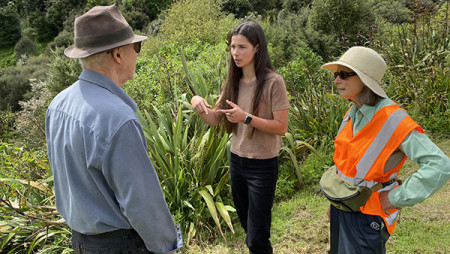
Volunteers Hannah (centre), Peter and Maxine discuss the ongoing restoration work in Mangaonua Gully
The group works closely with Hamilton City Council and local iwi Ngāti Haua. A path through the gully installed by the city council and upgraded about three years ago has proved very popular with walkers.
Long-time volunteer, Maxine Fraser – who has been with the group since it began – says the gully represents a piece of nature in the city.
“People come here to be reconnected with nature and the path attracts lots of families, especially in the weekends.
“We’ve seen a very positive response from the community,” says Maxine.
Hannah says the gully is an important reservoir of native vegetation in the city, where just two percent of native-dominant vegetation cover remains.
“Our aim is to restore the gully to its original condition prior to human disturbance,” says Hannah.
This includes developing a canopy, which shades out weeds and then planting under the canopy.
“I feel incredibly grateful to be part of the project and to have the opportunity to connect with the other volunteers and our partners. It's very rewarding.”